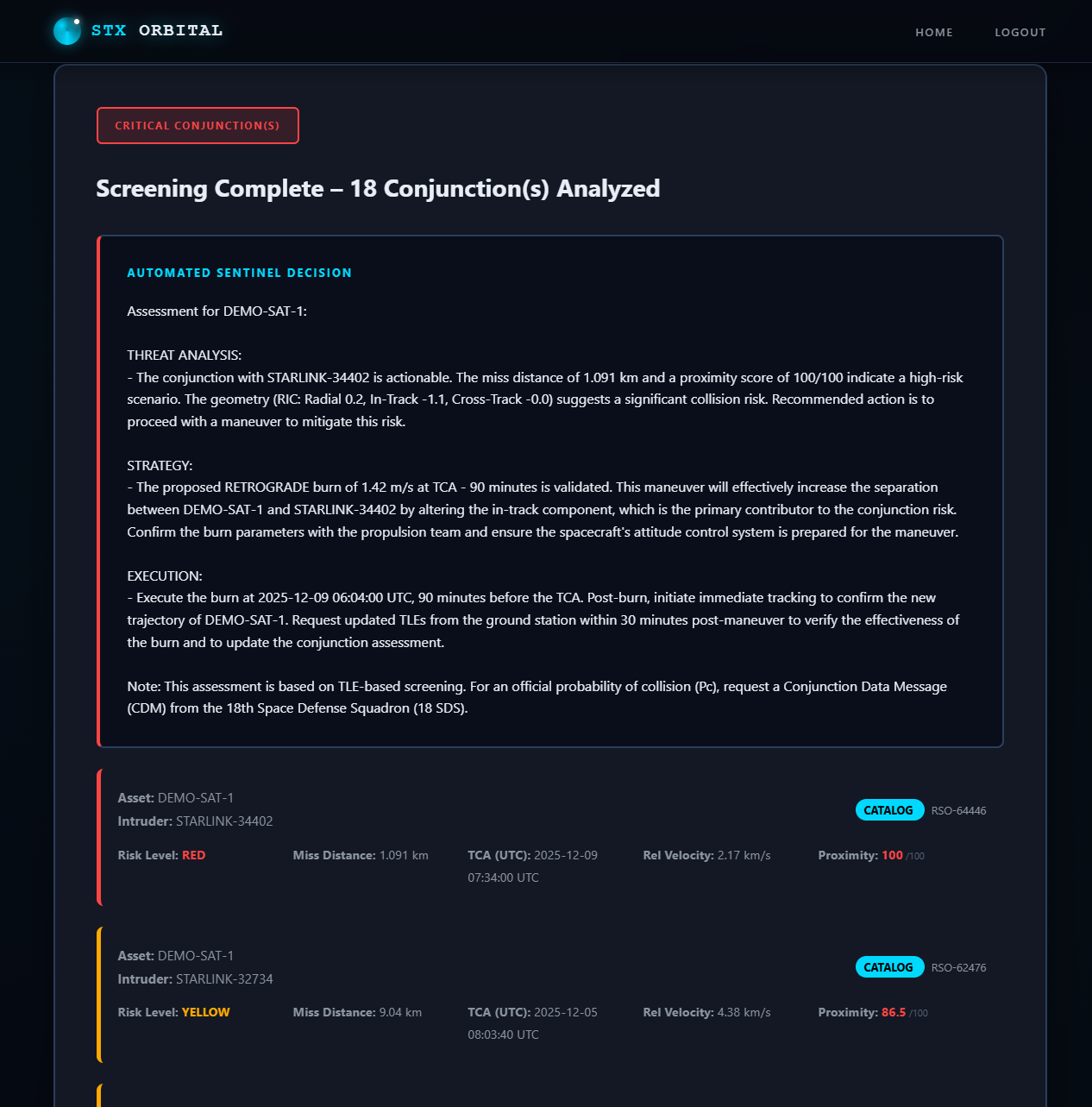
STX Orbital delivers autonomous collision avoidance for commercial and defense LEO operators. The STX Sentinel engine ingests TLEs or CCSDS CDMs, filters the full 60,000+ object catalog by orbital regime, and screens up to 10,000 priority objects to deliver actionable risk assessments in seconds.
STX Watchtower adds persistent monitoring: scheduled scans, automated alerts, and full audit traceability.
Free evaluation: 5 screenings, 7 days, no credit card required.
Sentinel accepts operator TLEs for catalog-wide screening or CCSDS CDM/XML for processing official conjunction data messages. Inputs are parsed, validated, and normalized into the Sentinel state model.
Operator objects are correlated against a continuously synchronized orbital catalog sourced from Space-Track.org public data. Object classification, priority tagging, and maneuverability flags are applied.
Sentinel propagates states, evaluates conjunction geometry, computes miss distances, and applies proximity scoring models. Tiered thresholds yield RED / YELLOW / GREEN classification with maneuver guidance.
Persist assets into Watchtower for continuous surveillance. Scheduled scans, automated email alerts, and timestamped event logs provide a standing conjunction-defense posture instead of reactive manual analysis.
Deterministic conjunction screening pipeline: SGP4/SDP4 propagation, coarse filtering, fine geometry evaluation, proximity scoring, risk classification, and maneuver-recommendation logic. Sub-second response on single objects, <35s for full catalog screening.
SGP4/SDP4 Proximity Score
Dedicated API endpoint built to support Operator-to-Operator ephemeris exchange with constellation operators. Infrastructure deployed and awaiting partner data agreements. Raw ephemeris never redistributed.
REST API Pending Access
Upload up to 100 TLEs at once for fleet-wide screening. Full risk report with maneuver recommendations for each asset. Processing time scales with fleet size and catalog depth.
Multi-Asset Fleet Reports
Automated burn recommendations based on conjunction geometry and miss distance. Includes delta-v estimates, burn direction, and recommended execution timing relative to TCA.
Δv Guidance Burn Timing
One-click branded PDF reports with timestamp, risk data, and maneuver vectors. Ready for FAA, FCC, ITU, insurance, or internal audit submission.
FAA/FCC Ready Signed & Dated
Separate RED/YELLOW thresholds for manned stations, constellation traffic, high-value assets, and general catalog. Fully configurable per asset.
RED Immediate Per-Asset Rules
100% US-owned, US-operated. All data processed and stored within United States infrastructure. On-premises and air-gapped deployment options available for programs requiring data sovereignty.
On-Prem Available Veteran-Owned
Every conjunction event is timestamped and stored with full context. Complete reconstruction available for regulatory reporting, insurance documentation, or post-incident analysis.
Full History Export Ready
Full REST API with OpenAPI 3.0 specification (Q1 2026). Enterprise authentication options including mTLS client certificates. Built to integrate into existing operator workflows.
OpenAPI Spec mTLS Ready
Same enterprise-grade screening accessible to academic missions and small operators. Free evaluation for mission planning. Educational pricing available for university satellite programs.
Free Eval EDU Pricing
Professional flight dynamics infrastructure. Priced for operators who understand that collision avoidance isn't optional — it's mission-critical.
For single missions and small constellations
For multi-mission operators and growing constellations
For large constellations and system integrators
For government programs requiring data sovereignty
FREE EVALUATION
Test STX Sentinel Before You Commit
5 screenings • 7 days • 200 priority objects • No credit card required
Start Free EvaluationFull access screens up to 10,000 priority objects from the complete 60,000+ catalog.
STX Orbital is onboarding a limited number of operators for early access. Participants receive hands-on integration support, priority feature input, and discounted rates in exchange for operational feedback.
Apply for Early AccessLEO conjunction volume is outpacing human analytical capacity. Legacy workflows designed for dozens of objects cannot scale to thousands. Collision avoidance must evolve from a reactive, manual process into a deterministic, autonomous defensive layer.
STX Orbital was built to bridge the gap between aerospace safety standards and modern distributed computing—providing operators with an auditable, always-on Flight Dynamics Officer.
The conjunction screening market is split between two camps: legacy defense contractors delivering black-box solutions at government scale and price, and academic spinoffs with sophisticated math but limited operational maturity. Neither is built for the commercial operator who needs to make maneuver decisions at 2am with full confidence in the underlying logic.
I spent 30 years in aerospace—flight test, Part 145 maintenance, aerospace management at OEMs and MROs. Every one of those environments had the same requirement: deterministic systems, full traceability, and zero tolerance for silent failures. When something went wrong, you could trace it back to a specific input, assumption, or decision point.
That's what I'm building here. The orbital mechanics are learnable—SGP4/SDP4 is a published algorithm, Pc estimation has standard formulations, and the 18th Space Defense Squadron publishes their methodology. The hard part isn't the math. The hard part is building infrastructure that behaves like safety-critical systems instead of a web application.
STX Orbital isn't trying to out-math the PhDs. We're applying operational rigor to a domain that desperately needs it. Every screening result includes explicit assumptions. Every threshold is auditable. Every failure mode is surfaced, not hidden.
If you're looking for a platform that tells you what you want to hear, we're not it. If you're looking for a platform that tells you exactly what it knows—and what it doesn't—we should talk.
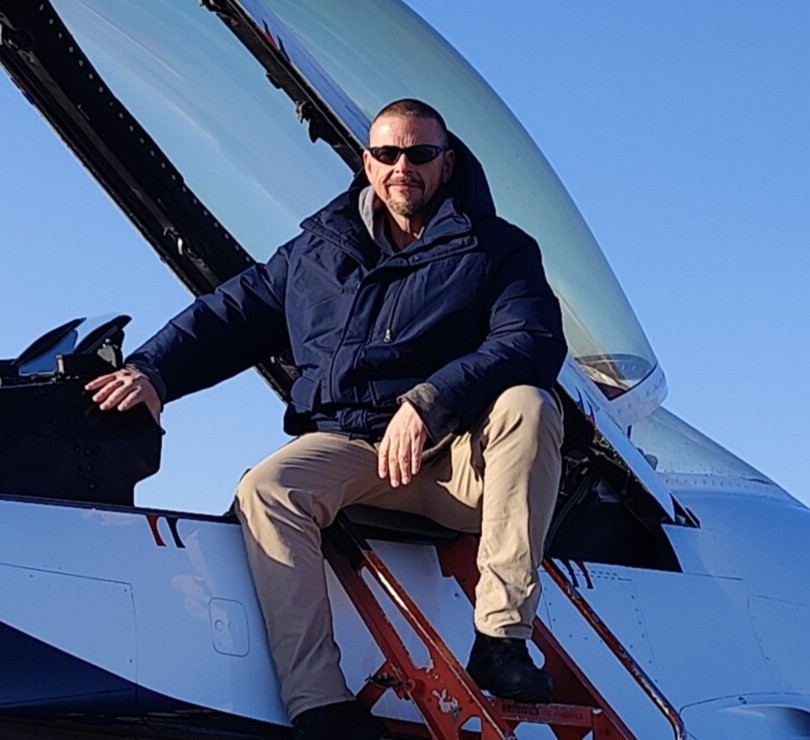
Robert Wingfield is the Founder of STX Orbital. His career spans 30 years of operational aerospace leadership across military flight test, business aviation, and defense programs. He has held avionics management and flight department leadership roles at Bombardier, Textron, and Raytheon — delivering aircraft through Part 135 operations, Part 145 maintenance, and customer acceptance. His military background includes USAF service as an F-16 crew chief, civilian avionics technician at the U.S. Naval Test Pilot School, and flight test operations on the E-8 JSTARS surveillance platform.
STX Orbital applies that operational discipline to space domain awareness: deterministic screening logic, full audit traceability, and infrastructure designed to behave like safety-critical avionics — not a web application.
STX Orbital Inc. — Veteran-Owned. Built in the USA.
Currently scaling operations to support enterprise integration and government programs.